Fundamental crypto scoring system centered on tokenholder value accrual, with each asset rated 1–5 across four time horizons. Built on the Crypto Asset Valuation Framework (CAVF).
What the scores, ratings, and terms on the board mean. The full framework is in the whitepaper.
Score and rating
Every token gets a score from 1.0 to 5.0 for each time horizon: 1 month, 6 months, 1 year, and 3 years. The score is a weighted average of eight dimensions, and the weights change with the horizon. The one-month horizon leans on supply, catalysts, and market structure. The three-year horizon leans on value accrual and competitive position. That is why the same token can rank differently at each horizon.
The score maps to a rating:
buy bands need upside*
1.02.02.83.53.84.25.0
Sell1.0–1.9
Underperform2.0–2.7
Neutral2.8–3.4
Accumulate*3.5–3.7
Outperform*3.8–4.1
Strong Buy*4.2–5.0
* A buy rating needs upside, so if a token scores in one of these buy bands but its base-case fair value is below today's price, it is rated Neutral instead. The reverse holds for the sell bands: if the base-case fair value is above today's price, the rating moves one step toward Neutral (Sell to Underperform, or Underperform to Neutral).
The eight dimensions
Dimension
What it measures
1 month
6 months
1 year
3 years
Quality
Product traction
Usage and revenue, and whether they are growing.
10%
20%
20%
20%
Value accrual
How much value reaches holders. The highest score it can get is set by the token's holder economics result.
10%
20%
20%
22%
Team & governance
Execution record, who controls the protocol, and how decisions get made.
5%
10%
10%
12%
Competitive position
Moat, market share, and the threats to it.
5%
10%
12%
16%
Market structure
Liquidity, listings, derivatives, and holder concentration.
20%
10%
8%
5%
Value
Valuation
Price against fair value and comparable tokens.
10%
15%
15%
12%
Dilution & supply
Token unlocks, new emissions, and circulating supply growth inside the horizon.
20%
10%
10%
8%
Catalysts
Dated events and overhangs inside the horizon.
20%
5%
5%
5%
Quality vs Value matrix
The matrix plots every token on two simpler scores, Quality and Value, built from the same eight dimensions. The two simpler scores are used only for the matrix. A token's final rating comes from the weighted score above.
Quality →Value →
Quality, priced inQuality, cheapWeak and expensiveCheap for a reason
Each dot is a scored token, colored by its 6-month rating: buy tier, neutral, or sell tier. The matrix on the scoreboard is live and labeled.
Quality
How good is the token?
Quality = average of the 5 quality dimensions
Product traction, value accrual, team & governance, competitive position, and market structure, each counted equally. None of these depend on timing, so a token's Quality is the same at every horizon.
Value
How cheap is it, and do supply changes and upcoming events help or hurt it?
Valuation is counted twice because price matters most. Dilution & supply and catalysts are judged over the horizon you pick, for example unlocks in the next month versus the next three years. That is why a token's Value can move when you switch horizons.
The top right holds strong tokens at cheap prices, so start there. Because Quality includes value accrual, a great business with a weak token scores lower on Quality, so it won't land in the top right just because it is cheap.
Holder economics
The CAVF conclusion. It answers whether the value the protocol creates actually reaches tokenholders, once the claim is tested for enforceability, leakage, and dilution. Each result also sets the highest score the Value accrual dimension can get.
up to 1Absent
up to 2Weak
up to 3Contingent
up to 4Partial
up to 5Strong
own scaleMonetary premium
Strong
Accrual is programmatic or has a consistent discretionary track record, leakage is low, and DAAY is positive.
Partial
Live accrual, weakened by leakage, discretion, or dilution.
Contingent
Accrual depends on a vote or decision that has not happened yet.
Weak
A mechanism exists, but leakage or dilution overwhelms it.
Absent
Nothing reaches holders: no mechanism is live or proposed, and the token has no required use.
Monetary premium
Monetary assets such as BTC, ZEC, and XMR. There is no holder cash-flow claim by design; the value is monetary premium (whitepaper Section 4.6).
The caps ensure that a great business with poor tokenholder value can't earn a high value accrual score. A token whose company keeps revenue separately from the token (an equity/token split) is capped at 3, because the company's shareholders, not tokenholders, have the first claim on that revenue. For Monetary premium tokens the value accrual dimension is shown as Monetary quality and scores the premium itself: how credible the supply policy is, how much dilution holders pay for security, how sustainable the security budget is, and how much new issuance goes to a development fund, foundation, or insiders rather than to the miners or validators who secure the network.
DAAY
Dilution-adjusted accrual yield. It nets what holders receive against the new supply they are diluted by.
DAAY = holder accrual yield − net issuance yield
Outstanding supply: every token issued to an owner, including locked team and investor tokens. It leaves out unallocated treasury, ecosystem, community, and foundation reserves.
Holder accrual yield: the yearly value that reaches holders through buybacks, burns, and distributions funded by protocol revenue, annualized from a recent window (usually the last 30 or 90 days), divided by the market value of outstanding supply. Buybacks count when the tokens are bought; if the treasury later releases bought-back tokens instead of burning them, they count as issuance.
Net issuance yield: growth in outstanding supply over the trailing 12 months from new emissions, governance-authorized minting, staking subsidies, and tokens leaving reserves (incentives, grants, sales, and ecosystem or foundation releases).
Burns count once, in holder accrual yield, so they are not double counted.
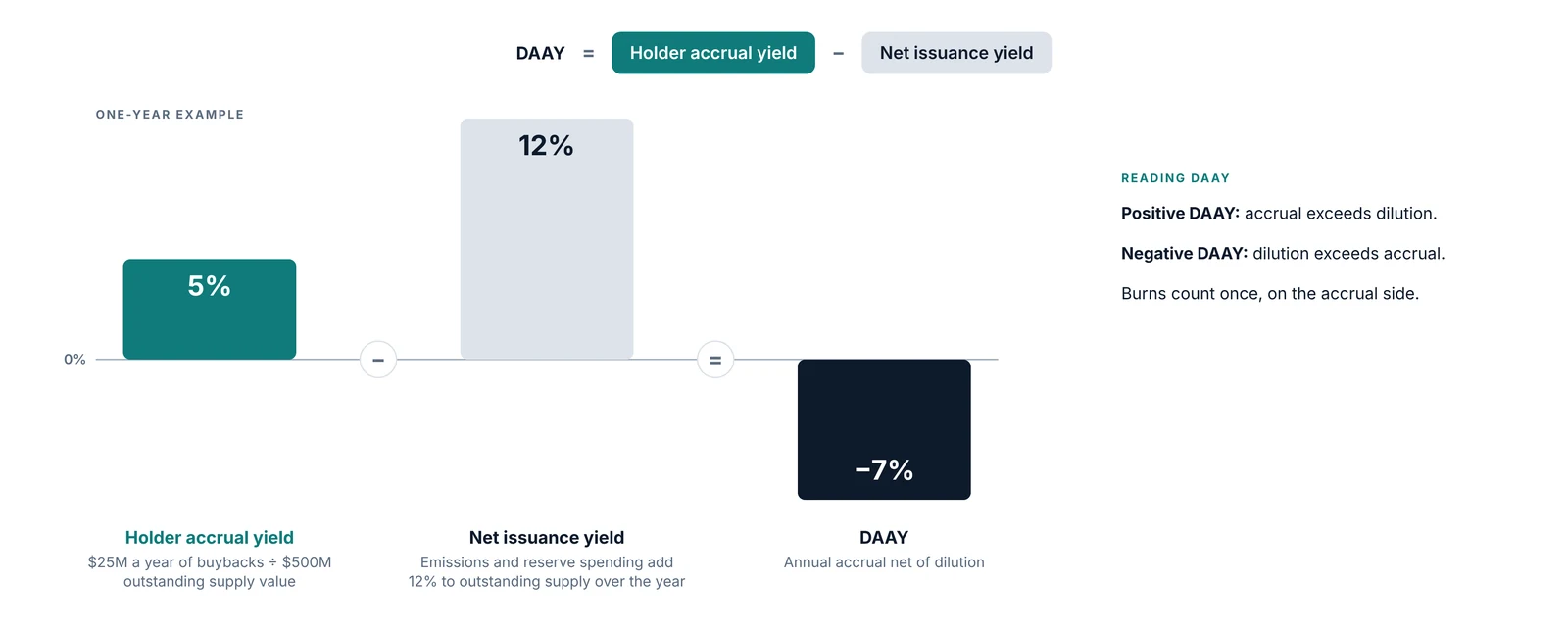
ExampleA token's outstanding supply is worth $500M, and it spends $25M a year on buybacks and burns, so its holder accrual yield is 5%. Emissions and incentives paid from reserves add 12% to outstanding supply over the same year. DAAY = 5% − 12% = −7%. The buybacks offset less than half of the new supply.
Holder accrual yield+5%
Net issuance yield−12%
DAAY−7%
A positive DAAY means accrual is outrunning dilution. A negative DAAY means holders are being diluted faster than they are paid.
Unlocks are tracked separately. Team and investor tokens are already outstanding before they unlock, so an unlock doesn't change any holder's share. The board counts unlocks in the Dilution & supply score and the technicals instead, since they add sellable tokens and near-term selling pressure. Reserve tokens (ecosystem, community, or foundation) count as issuance only when they leave the foundation or treasury through grants, incentives, distributions, or sales, because that is when they can reach the market. Tokens that vest into a foundation wallet and stay there are still reserves. Where those wallets can't be seen onchain, the review uses the vesting date instead and notes it.
Holder accrual duration. A buyback or payout program with an end date counts toward the base-case fair value until it ends, with the usual discount for how enforceable it is. After that, it counts only as much as it is likely to be renewed (e.g., a program with a 50% chance of renewal counts at half value). A program the team can change at any time is discounted as discretionary. DAAY still shows the yield actually observed.
Some tokens own the business instead of receiving payouts. Through governance, holders control the treasury, the IP, and the right to issue new tokens, while the team runs the business on a budget holders oversee. Like a company that pays no dividend, such a project may reinvest all of its revenue, so a low DAAY doesn't, by itself, lower its value accrual score. The board values these as treasury plus business value, discounted by how well the structure protects holders:
Who holds the IP, and who controls the treasury? Can holders recover funds if the project winds down?
Who controls new issuance, and who approves spending above the budget?
Do insiders earn their stake on a time-based schedule or by hitting token price targets?
Can the revenue be verified? Offchain revenue counts in full only when it settles onchain or is backed by audited or attested reports; otherwise the review marks it unverified.
If an ownership token also runs buybacks or distributions, they are not added on top, because they pay out cash the business value already includes.
A buyback creates value for holders only when the protocol buys below fair value. The protocol pays with treasury money, or revenue that would otherwise go to the treasury, which belongs to all holders and was already part of each token's value. Whether the tokens it buys are burned or held in the treasury, they leave the market, so each remaining token owns a larger share of the business. That larger share is worth more than the cash given up only when the buyback price is below fair value. Above fair value, the protocol overpays sellers out of the shared treasury.
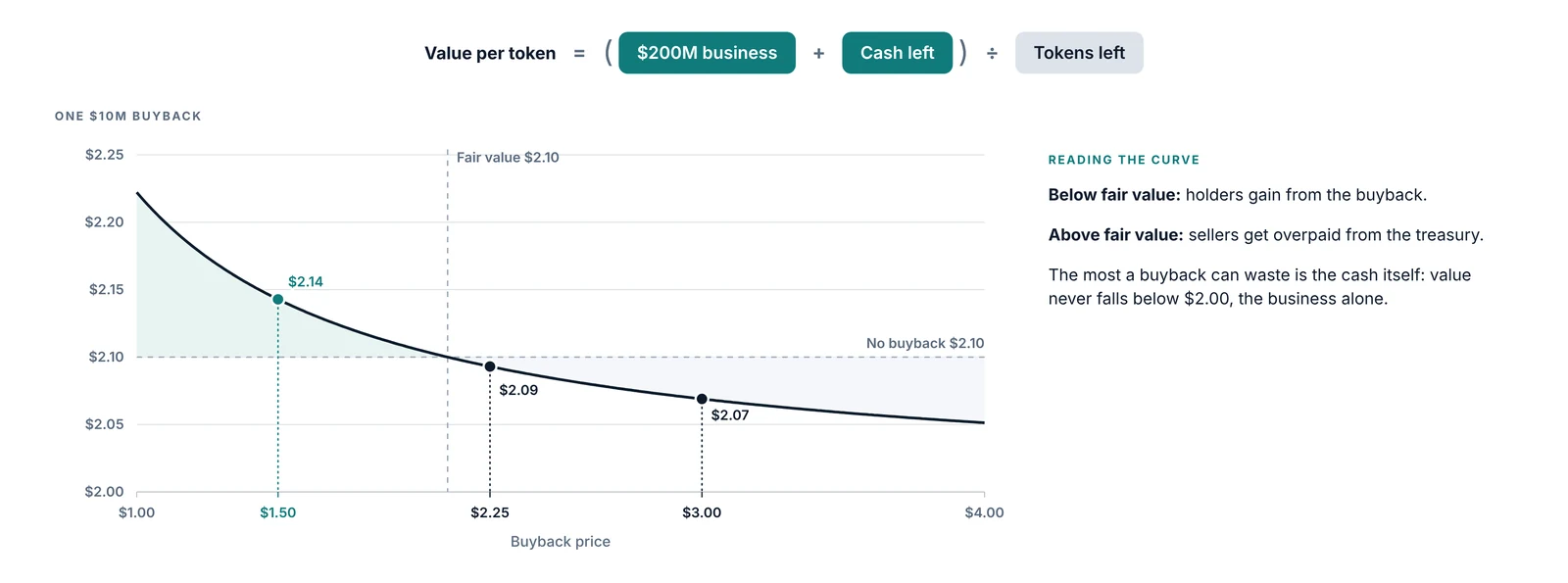
ExampleA protocol's business is worth $200M, its treasury holds $10M of cash, and 100M tokens are outstanding, so each token's fair value is $2.10. Spending the $10M at $1.50 takes 6.7M tokens off the market (worth $14M) and leaves each token worth $2.14. Spending it at $2.25, just above fair value, takes 4.4M tokens off the market (worth $9.3M) and leaves each token worth $2.09. Spending it at $3.00 takes only 3.3M tokens off the market (worth $7M) and leaves each token worth $2.07. At $3.00, the protocol overpays sellers by $3M out of the shared treasury, even though the buyback reduces supply and raises DAAY.
When a token's value accrual comes mainly from buybacks, its review reports whether recent buying ran above or below the base-case fair value, as a dated warning. That check doesn't change the score, since price is already scored under valuation. The value accrual score rates the program's design instead: whether the buyback is enforced by code or left to someone's discretion, whether it takes price into account or buys mechanically, who decides between buybacks and reinvestment, and whether the spending is disclosed well enough to measure.
Base FV is our base-case estimate of what the token will be worth one year from now, shown as the % above or below today's price. The estimate comes from the valuation method that fits the token's tokenholder claim, with any monetary or speculative premium sized separately. For tokens valued mainly on monetary premium (BTC, ZEC, and XMR), the base case sizes that premium directly. Base FV is a scenario estimate, not a price target.
Each review sets three scenarios (bear, base, and bull) and gives each a probability. The rating follows the base case, the most likely scenario, not the probability-weighted average of all three (the expected value). That way a small chance of a very large bull case can't lift a rating on its own.
When the price is above the base case, reviews of tokens valued on their claim split the gap into three parts: (1) monetary premium, counted only where there is evidence the token is used as money; (2) the difference between the base case and the bull case, which reflects the market pricing in more growth than our base case; and (3) any price above the bull case, which is speculative premium. Some reviews also add a reverse DCF, which works backward from today's price to show how fast holder accrual would need to grow over the next five years to justify it. Neither the gap breakdown nor the reverse DCF changes the score.
Technicals (Constructive, Neutral, or Extended) describe the price trend. They never change the 1.0 to 5.0 score, but they can lower the rating (the Accumulate, Neutral, or other label the score maps to): at the one-month horizon, Extended technicals (a price stretched after a sharp run-up) can move the rating down one or two steps, for example from Outperform to Accumulate. A large unlock can do the same at 1 month, and at 6 months, 1 year, or 3 years it can lower that horizon's rating one step if it falls inside the horizon. Neither ever raises a rating.
Confidence (high, medium, or low) says how well sourced the inputs are. Each dimension gets its own confidence rating. High means primary data (onchain data, exchange data, and filings), medium means credible secondary sources, and low means team claims, inference, or conflicting sources. A token's overall confidence is the weakest of product traction, value accrual, and valuation, and it does not change with the horizon. It does not change the score, but a Strong Buy needs medium or high confidence. Tokens with low confidence are marked with a small ring next to the ticker, and the token's detail view says what would raise it.
Refreshes and sources
The board refreshes weekly: prices, technicals, comparables, and each token's fees, revenue, and supply. Prices come from Blockworks; market caps and supply from CoinGecko; fees, revenue, and holders revenue from DefiLlama; daily closes from Binance and Blockworks; and perp open interest from Binance, Bybit, and OKX, with Blockworks for Hyperliquid. Ratings never change automatically: each change is a judgment made in the refresh, and the board lists the last week's changes. The header's refresh date is the date every token has been updated by, and each token's detail shows its own. Each token's Key metrics tab names its revenue source, and its Sources tab lists the rest.
Using the board
Click a row to open the full review. Switch between List and Table, sort by any column, and use Filters to narrow by rating, holder economics, class, or technicals. "Copy link" in a review gives a direct link to that token at the current horizon. Dotted-underlined terms show a definition when you hover or tap them.
Protocol economics and tokenholder economics are structurally different, so crypto asset valuation requires a tokenholder-specific framework. In traditional equity analysis, enterprise value, operating cash flows, and shareholder claims are usually linked through a well-defined legal and economic structure. In crypto, that link is frequently absent, discretionary, indirect, or routed through mechanisms that are not equivalent to enforceable shareholder rights.
In this paper, I introduce the Crypto Asset Valuation Framework, or CAVF, which I developed to establish whether protocol-generated value creates a measurable economic benefit for tokenholders and through what mechanism. The framework is based on four core elements: (1) a standardized economic flow map, (2) a tokenholder-specific classification system with a premium overlay, (3) an enforceability, leakage, and dilution adjustment layer, and (4) a valuation method-selection matrix.
To measure dilution, CAVF adapts net payout yield from equity analysis into dilution-adjusted accrual yield (DAAY), which shows how much value reaches holders after accounting for new supply. The framework also values monetary and speculative premium after the tokenholder claim, so any value the claim cannot explain stays visible. It covers ownership tokens, where holders control the treasury and IP instead of receiving distributions, and tests whether buybacks or reinvestment create more value at a given token's current price. The paper then applies the framework to eight case studies across all five token categories.
The goal is to reduce one of the most common errors in crypto valuation: underwriting a protocol's economics and buying a token that has no claim on them.
1 Why Crypto Needs a Tokenholder-Specific Valuation Framework
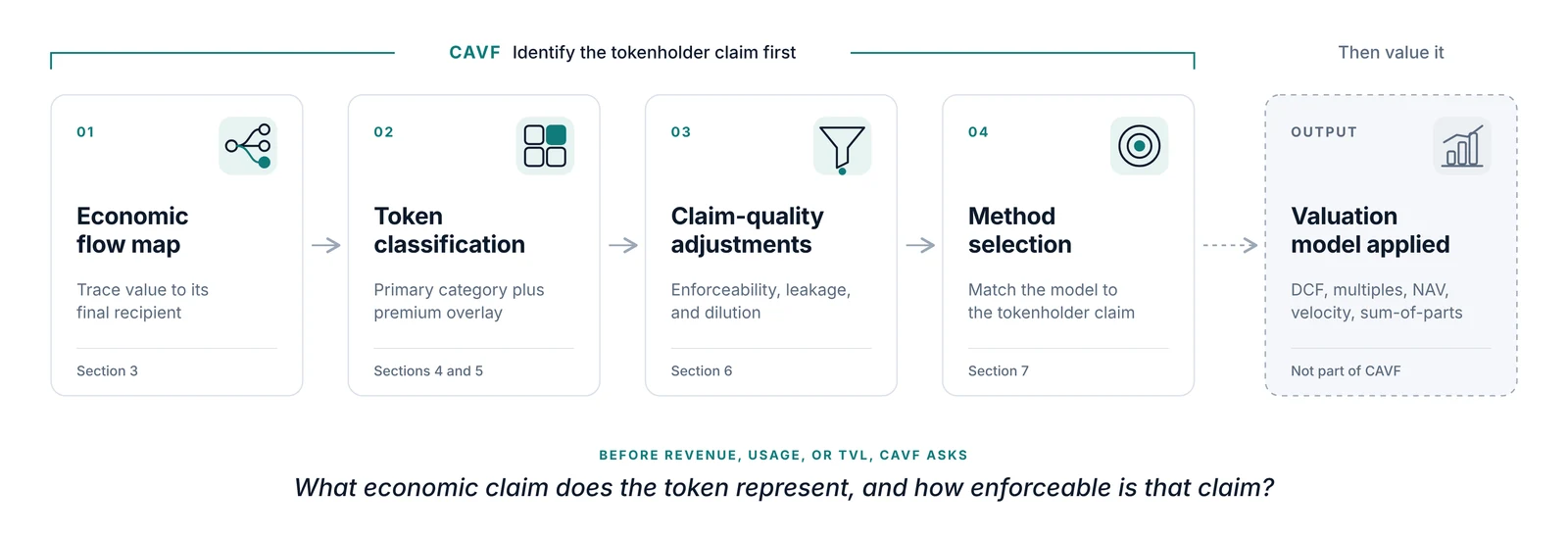
Figure 1. CAVF identifies the tokenholder claim before any valuation model is applied.
The crypto market is at a turning point. Institutions are no longer only observing the asset class from the outside. They are allocating capital, building infrastructure, and launching products, all of which require more rigorous valuation work. Spot bitcoin ETPs, approved in the U.S. in January 2024, opened regulated access to bitcoin exposure.1 In the 2025 Coinbase and EY-Parthenon institutional investor survey, 83% of respondents planned to increase their digital asset allocations that year.2 Regulation has also begun to formalize. The GENIUS Act, signed in July 2025, created a federal framework for payment stablecoins.3 In March 2026, the SEC and CFTC issued a joint interpretation that sorted crypto assets into categories and found that most of them are not securities.4 In August 2026, the SEC proposed Regulation Crypto Assets, which would create new exemptions for token offerings and a safe harbor for tokens whose issuers have finished or stopped the work they promised.5 The CLARITY Act, which would set rules for the broader market, passed the House in July 2025 but failed a Senate cloture vote in September 2026.6
Despite this progress, no standardized framework for valuing crypto tokens exists, and the market increasingly needs one. Token designs are becoming more complex, with some tokens now structured to own the business outright. Protocols are generating measurable revenue and choosing between buybacks and reinvestment, and investors are emphasizing fundamentals again, likely for good this time. As more capital enters the market, the gap between protocol value and token value becomes harder to ignore.
Traditional equity valuation assumes that shareholders own an enforceable residual claim on the company. Most tokens carry no such right. A token may instead govern a protocol, secure a network, pay for usage, coordinate work, absorb risk, represent a share of a treasury, or simply exist next to a valuable business. None of these roles guarantees that a protocol's value reaches its tokenholders.
This paper starts from that gap. Before anything else, CAVF asks:
What economic claim does the token represent, and how enforceable is that claim?
2 Protocol Value Does Not Equal Token Value
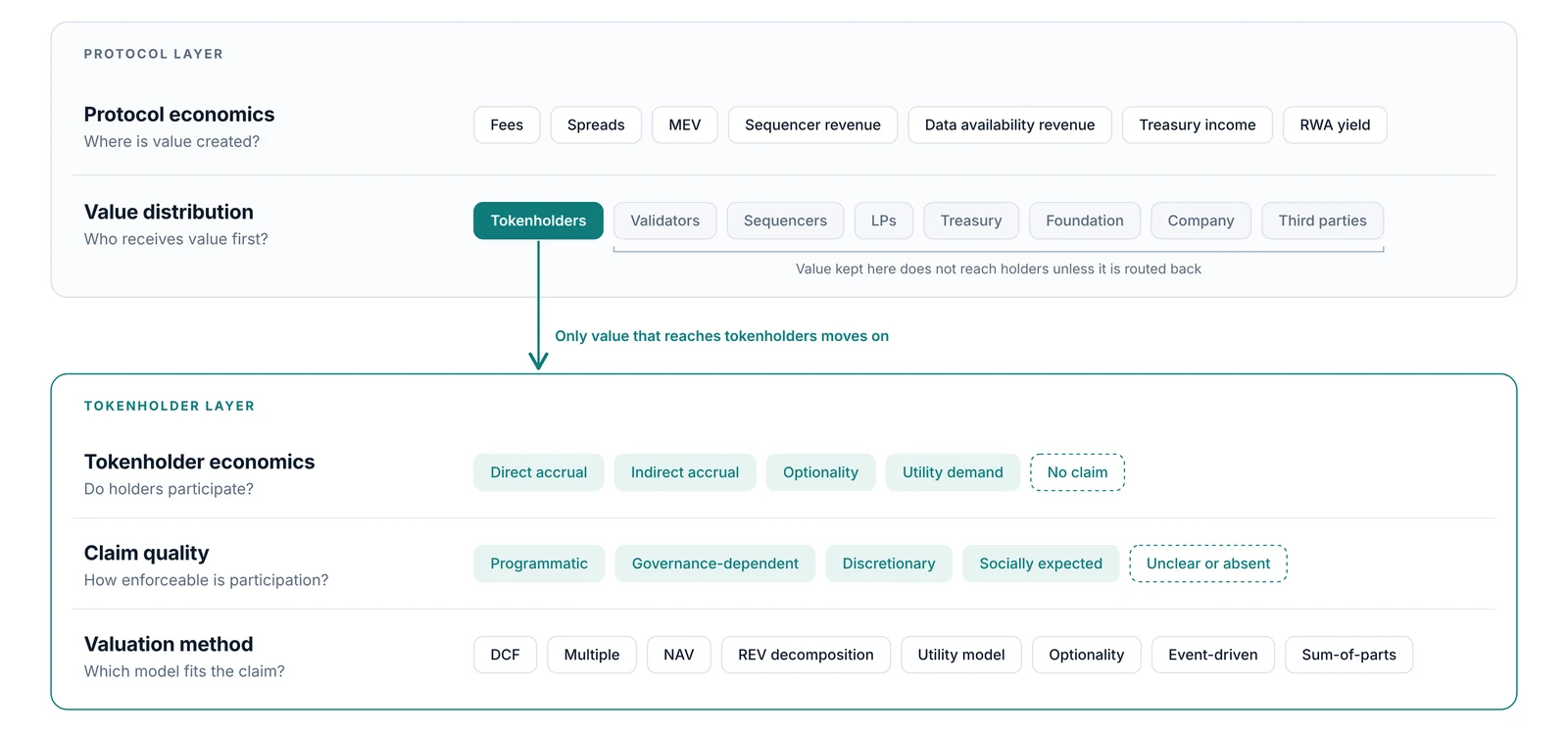
Figure 2. Protocol economics and tokenholder economics are separate layers. Only value that reaches tokenholders moves on to valuation.
Valuing a crypto token starts with separating protocol economics from tokenholder economics.
Protocol economics describe where value is created and monetized. Sources of that value can include fees, spreads, maximal extractable value (MEV), sequencer revenue, data availability revenue, treasury income, and real-world asset (RWA) yield.
Tokenholder economics describe whether any of that protocol-generated value reaches the tokenholders. Value can reach the token through buybacks, burns, staking distributions, protocol revenue sharing, treasury ownership, required token usage, collateral demand, governance-controlled capital allocation, or other mechanisms.
These two layers are often conflated. A protocol can process billions of dollars of volume and still provide no measurable economic benefit to tokenholders. A network can generate real economic value (REV) that accrues to validators, sequencers, builders, or applications rather than passive tokenholders. A company can build a valuable product around a protocol while the token remains economically junior or irrelevant.
I built CAVF because a strong business does not guarantee a strong token.
For most investors, the token is the only way in. The equity usually sits with founders and venture investors, so tokenholders own only what the token captures. CAVF separates the business from the token by tracing where value is created, who receives it, whether tokenholders participate, and whether that participation is durable enough to support a valuation model.
3 Economic Flow Mapping
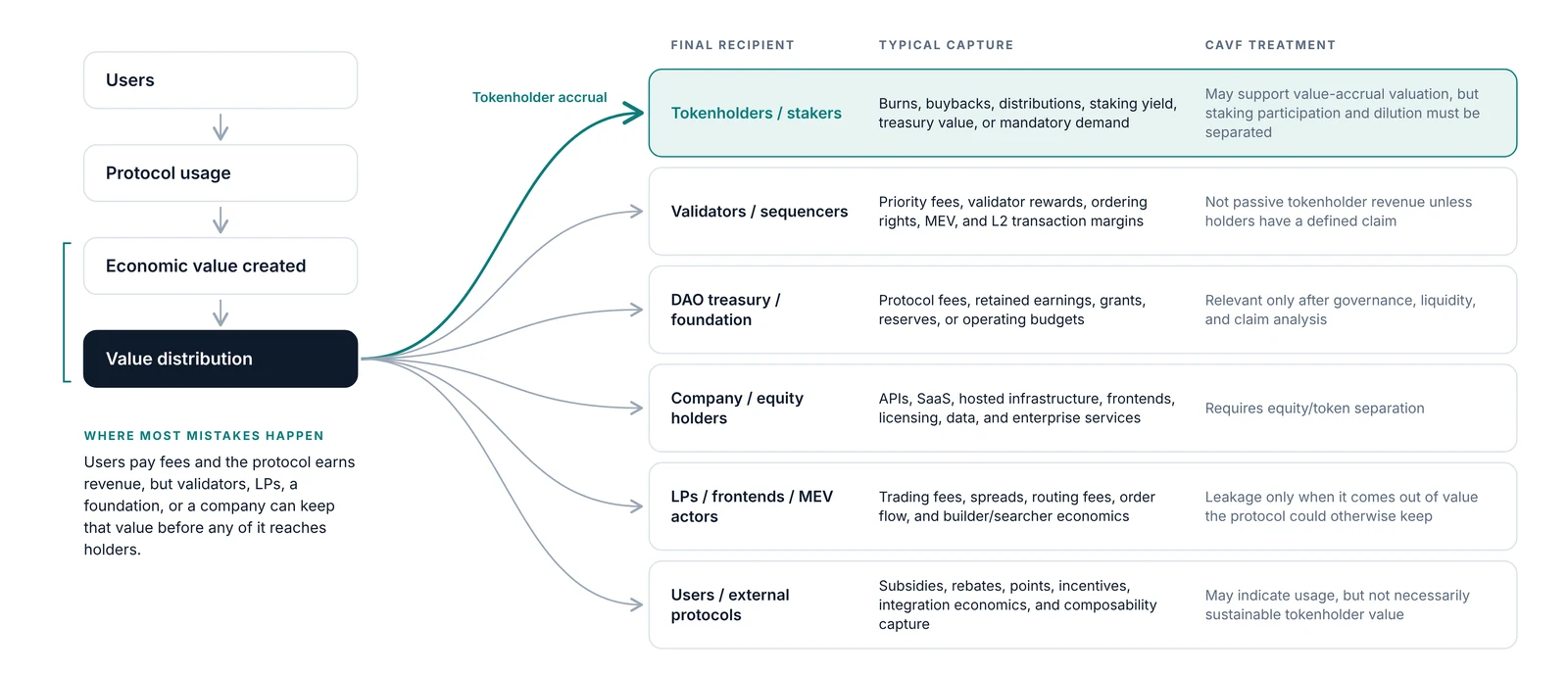
Users → Protocol Usage → Economic Value Created → Value Distribution → Tokenholder Accrual
CAVF traces each token's path from users to tokenholder accrual. Most valuation mistakes happen between "economic value created" and "tokenholder accrual." Users pay fees, and the protocol earns revenue, but validators, liquidity providers (LPs), a foundation, or a company can keep that value before any of it reaches holders. Mapping value distribution shows who ends up with the value.
Figure 3. The final-recipient map shows whether protocol economics become tokenholder economics.
The result is a final-recipient map that lists who receives the value the protocol creates and, where the data allows, how much each recipient gets.
4 Token Classification
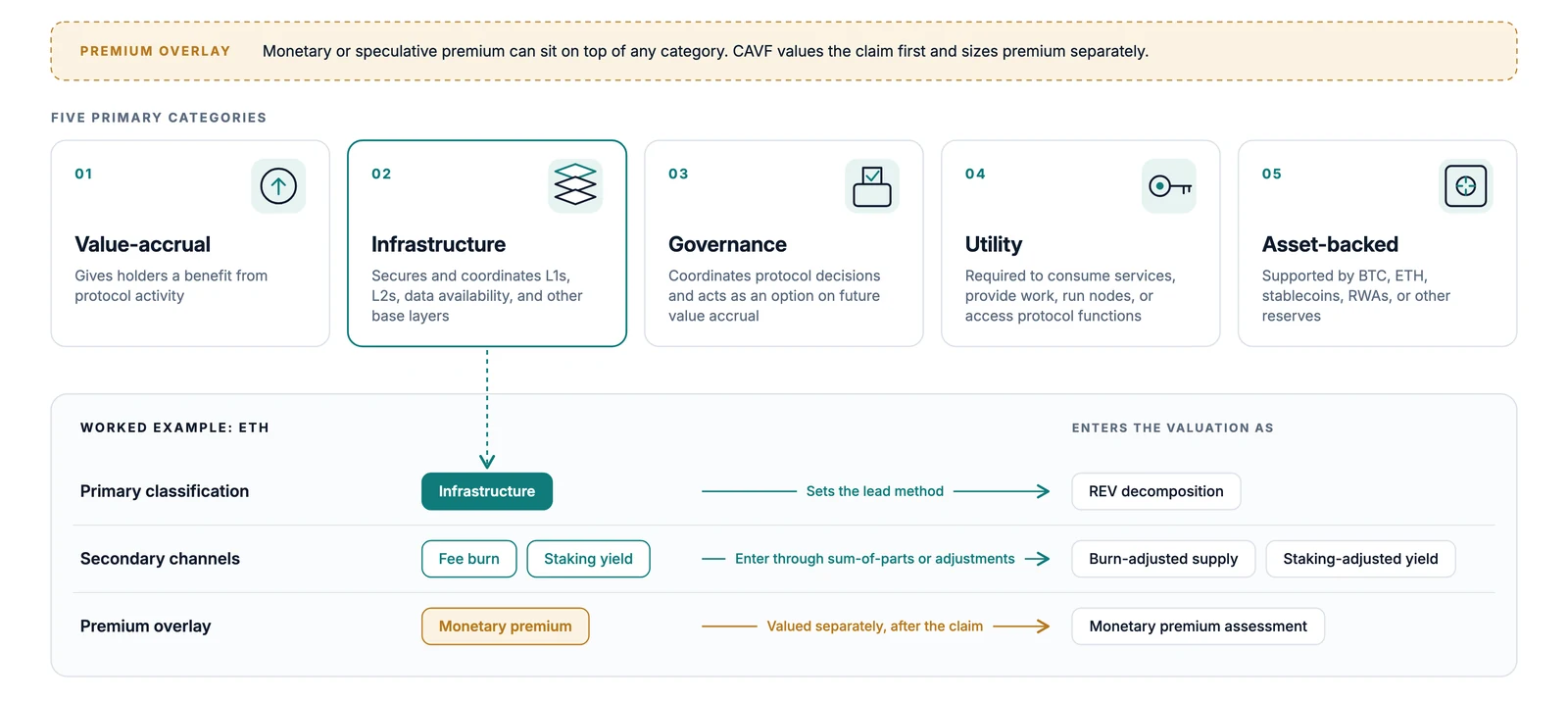
CAVF classifies each token by its economic relationship to protocol-generated value and sorts tokens into five primary categories:
Value-accrual tokens
Infrastructure tokens
Governance tokens
Utility tokens
Asset-backed tokens
Tokens rarely fit a single category. Most combine several economic roles, so CAVF assigns each token a primary classification based on its dominant tokenholder claim, then tags any secondary channels that also carry value. The primary classification sets the lead valuation method, and the secondary channels enter through sum-of-parts or as adjustments. Monetary or speculative premium can sit on top of both, and CAVF sizes it separately (Section 4.6).
Figure 4. Each token gets one primary category. Secondary channels are added as adjustments, and premium is valued separately.
4.1 Value-Accrual Tokens
Value-accrual tokens give holders an economic benefit from protocol activity, whether or not those holders have formal legal cash-flow rights. Accrual can reach holders directly, through buybacks, burns, or distributions, or indirectly, such as through staking requirements that reduce circulating supply. Section 6.1 covers how enforceable each mechanism is.
This category is the closest to equity analysis, but most value-accrual tokens give holders no legal right to protocol cash flows, which leaves protocols free to reduce or stop accrual without holders' consent.
Accrual usually starts with a fee switch or revenue-sharing policy that directs a share of protocol fees toward tokenholders. Its value depends on which fees are included, whether the policy can be reversed, and what share reaches tokenholders. The mechanisms below determine how that share actually reaches holders.
How Value Accrues
Buybacks and burns: The protocol spends revenue or treasury assets to buy the token, and may burn it to permanently reduce supply. CAVF discounts this accrual for the risk that the program is paused, stopped, or not renewed (Section 6.1).
Staking and distributions: Participating holders receive protocol-generated value. CAVF separates this value from passive-holder economics and inflation-funded yield.
Treasury retention: Protocol earnings accumulate in a treasury governed by tokenholders. The treasury can support value, but only after discounting for liquidity, governance control, and spending policy.
Demand sinks: Unlike the channels above, demand sinks do not depend on protocol fees. Protocol growth creates demand for the token when users must buy, hold, or lock it to use the protocol. A demand sink supports value only if users keep holding the token instead of selling right away.
Best-Fit Valuation Methods
Value-accrual DCF: Fits when tokenholder accrual is recurring, measurable, and predictable enough to forecast.
Tokenholder revenue multiple: Fits when current accrual exists but long-term forecasts are too uncertain for a DCF.
Treasury-adjusted Net Asset Value (NAV): Fits when the treasury is liquid, material, and credibly controlled by tokenholders.
Event-driven accrual model: Fits when accrual depends on a specific proposal that has not passed yet, like a vote to turn on a fee switch.
4.2 Infrastructure Tokens
Infrastructure tokens secure and coordinate blockchain infrastructure such as Layer-1s (L1s), Layer-2s (L2s), data availability layers, sequencing networks, settlement systems, oracle networks, shared security systems, and other base-layer or middleware networks. These tokens often combine several roles, including gas asset, staking asset, collateral asset, settlement asset, governance asset, and monetary asset.
Infrastructure tokens usually capture value through several channels at once. The same network activity can produce fee burn, validator income, staking yield, sequencer profit, treasury revenue, MEV, and monetary premium, and each channel pays a different recipient. One combined earnings figure overstates what reaches tokenholders, so CAVF counts each channel separately.
How Value Accrues
Fee burn: Usage removes tokens from the supply. A burn helps holders only if it outpaces new issuance.
Staking economics: Stakers may earn yield from newly issued tokens, transaction fees paid by users (including priority fees), and payments from searchers competing to capture MEV. Only fee-funded yield counts as accrual. Yield paid in new tokens is dilution for holders who do not stake. The new supply only goes to stakers, so everyone else's share of the network shrinks.
Validator and sequencer economics: Infrastructure networks pay the operators who run them, such as validators and sequencers, before holders receive any fees or revenue. How much reaches holders depends on who controls these operators, whether holders can share in their income by staking with them, and whether governance can redirect their profits.
Treasury retention: Infrastructure revenue may accrue to a decentralized autonomous organization (DAO), foundation, or operating entity. That revenue counts as tokenholder value only if holders have a claim on it and can control how it is spent.
Monetary premium sits on top of these channels and is covered in Section 4.6.
Best-Fit Valuation Methods
REV is the total fees and tips users spend to get transactions onto a blockchain. Every infrastructure valuation starts by splitting REV into base fees, priority fees, MEV payments, and blob or data fees, then tracing whether each part is burned, paid to validators, or kept by sequencers or applications.
Burn-adjusted supply model: Fits when usage mechanically reduces supply.
Staking-adjusted yield model: Fits when stakers receive a share of REV.
Security budget model: Fits when the token's value depends on paying validators enough to keep the network secure.
Sum-of-parts: Fits when two or more sources of value coexist, such as fee burn, staking yield, or treasury value.
4.3 Governance Tokens
Governance tokens coordinate protocol decision-making. They may control fee switches, treasury deployment, emissions, risk parameters, collateral onboarding, liquidity incentives, protocol upgrades, grants, and operating budgets.
A governance token works like an option on future value accrual. Until governance turns on a fee switch, buyback, or distribution, holders receive nothing from protocol revenue. Revenue sets the upper bound of what the option could be worth. The more likely governance is to turn on value accrual, the closer the token's value gets to that bound.
How Value Accrues
Future fee switch: Governance may turn on a fee switch or redirect existing fees to buybacks, burns, or payments to stakers.
Treasury deployment: Governance may use liquid treasury assets for buybacks or distributions. CAVF discounts treasury value when insiders control spending or governance can direct it elsewhere.
Risk backstop: Holders may stake the token to cover protocol losses, such as bad debt, in exchange for a share of fees. If losses occur, the protocol can take staked tokens to cover them.
Strategic control: Governance can have value when it controls scarce infrastructure, protocol parameters, or the route through which future economics must pass.
Execution credibility: Optionality improves when proposals are binding, executable, and supported by a track record of governance follow-through.
Best-Fit Valuation Methods
Governance optionality: Fits when there is no pending proposal to send value to holders, so the token is valued as an option on protocol revenue.
Event-driven accrual model: Fits when one or more proposals to send value to holders are pending and the likelihood, size, and timing of each can be estimated.
Treasury-adjusted NAV: Fits when the treasury is liquid, material, and credibly controlled by tokenholders.
4.4 Utility Tokens
Users need utility tokens to pay for services such as compute, bandwidth, or storage, and operators need them to run nodes or perform work for the network.
They are common in decentralized physical infrastructure networks (DePIN) and in AI, oracle, and privacy networks.
A utility token can have heavy usage and still fail to hold value. Usage creates token value through the mechanisms below.
How Value Accrues
Mandatory usage: Users or workers must buy the token and hold or spend it to use the service. If they can pay in stablecoins or an application swaps the token for them in the background, usage creates little lasting demand.
Token sinks: Tokens must be held, staked, bonded, burned, or otherwise retained long enough for demand to affect value, rather than being sold right away.
Collateral requirements: Node operators, service providers, or workers may need to lock up tokens as a security deposit that can be taken away (slashed) if the service is not delivered. Locked collateral reduces float and aligns incentives.
Emission pressure: New supply from incentives and rewards works against every channel above, and token unlocks add selling pressure. Organic demand has to grow faster than new supply for the token to hold its value.
Best-Fit Valuation Methods
Token velocity model: Fits when the token functions as a required medium of exchange inside the protocol.
Usage-to-sink model: Fits when service consumption creates measurable burns, locks, or other persistent sinks.
Staking-adjusted utility model: Fits when collateral requirements remove supply from circulation.
Equilibrium supply-demand model: Fits when emissions and unlocks are large enough to outpace organic demand.
4.5 Asset-Backed Tokens
Asset-backed tokens are backed by BTC, ETH, stablecoins, RWAs, protocol-owned reserves, structured credit assets, treasury assets, or other balance sheet resources. Valuation starts with NAV, then tests how much of it holders can actually claim.
A large treasury can provide limited tokenholder value if its assets are illiquid, controlled by insiders, subject to liabilities, or unavailable to holders.
How Value Accrues
Reserve claim: Reserves add value to the token only to the extent holders have a claim on them, through redemption rights, a governance-controlled path to distributions, or proceeds in a wind-down.
Redemption mechanics: Redemption ties token price more closely to NAV. Without it, CAVF applies a governance or liquidity discount to NAV.
Reserve income: Treasury assets may generate yield, but holders benefit only if that income is distributed to them or added to reserves they have a claim on.
Residual value: Liabilities, senior claims, custody arrangements, and duration risk determine how much backing remains for tokenholders.
Transparency and marking: Reserve reporting, asset quality, liquidity, and mark-to-market discipline determine confidence in NAV.
Best-Fit Valuation Methods
NAV model: Fits when holders can redeem at or near NAV.
Premium/discount to NAV: Fits when redemption is limited or absent, or when holder access depends on governance.
Yield spread analysis: Fits when reserve assets generate recurring income that reaches holders.
Liquidation stress test: Fits when liabilities, senior claims, or redemption pressure could leave holders with less backing than NAV suggests.
4.6 Premium Beyond the Tokenholder Claim
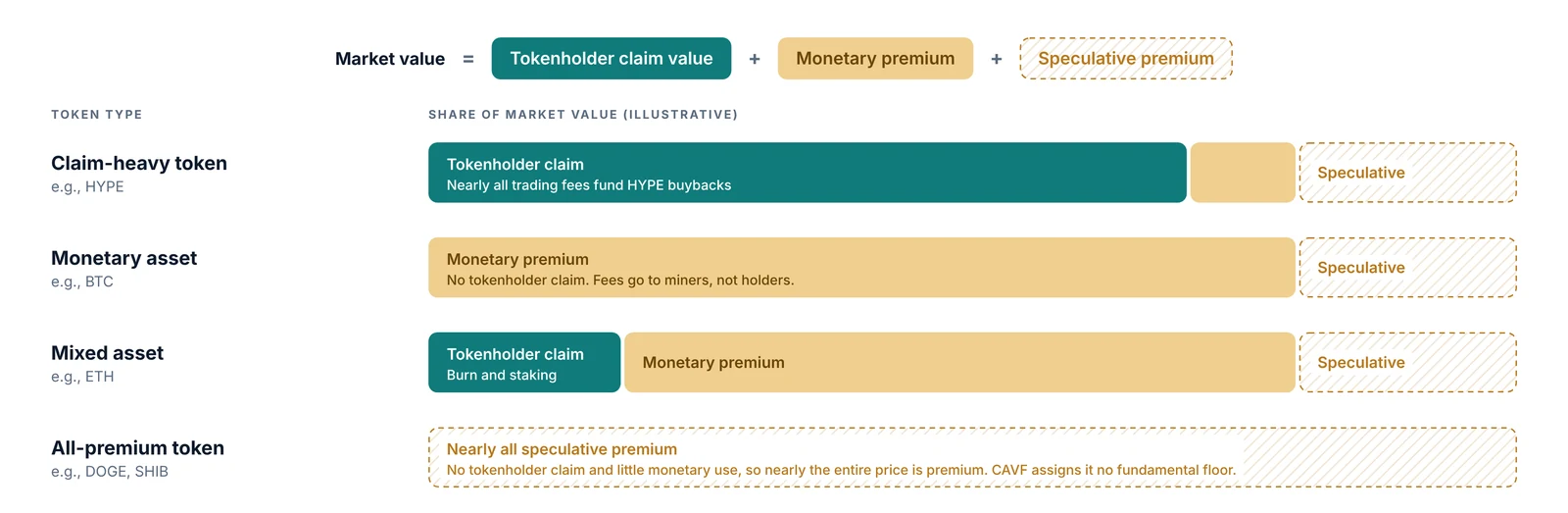
Premium is the portion of a token's market value that comes from something other than the tokenholder claim. The five categories above measure the claim. Premium measures what the market pays for everything else, such as money-like use or speculation.
Figure 5. How much of a token's market value comes from the claim versus premium, by token type.
CAVF values the claim first and then compares it to the market price. The alternative, starting from the price and working backward, can justify almost any valuation. It assumes the price is correct, so whatever the claim cannot explain gets labeled as future accrual. Valuing the claim first avoids the circular logic and shows how much of the price the claim does not support.
But not all of the gap between price and claim value is premium. Some of it may be model error, since a claim valuation that misses a revenue line, misjudges growth, or uses the wrong discount rate will be off by some amount. Another part may reflect a market that forecasts more accrual than the base case does. A higher forecast is a different view of the claim, not value beyond it.
CAVF splits the gap in three steps. First, monetary premium is counted only where the token shows measurable money-like use, and it is sized with the methods below. Second, any remaining price up to the bull case is read as a higher forecast because a reasonable scenario for the claim can justify it. Where the token has measurable accrual, a reverse DCF (Section 7) shows the growth the price assumes. Third, any price above the bull case is speculative premium, the part no reasonable scenario for the claim can explain. If holders have no claim on accrual, current or future, the market has nothing to be optimistic about, and the entire non-monetary gap is speculative premium.
The three steps cannot separate out model error, so CAVF values the claim as a range rather than a single number, and the bull case has to be a reasonable scenario rather than a stretch.
Sources of Premium
Monetary premium: The token is held and used as a money-like asset. Examples include a store of value, collateral in lending markets, a settlement or gas currency, a reserve asset for treasuries and institutions, or a unit of account for pricing other assets. It is strongest when liquidity is deep, collateral acceptance is broad, supply policy is credible, and the network has a long operating record. BTC is the clearest case, while ETH and SOL carry a monetary premium alongside their infrastructure economics.
Speculative premium: The token is held for expected price appreciation, community identity, or attention beyond what its claim or monetary use can support. Memecoins such as DOGE and SHIB are the clearest cases because they have no tokenholder claim and little monetary use, so nearly their entire price is speculative premium. The premium rests on reflexive expectations, coordination around a shared symbol, and a lottery-like payoff profile. Other tokens can carry speculative premium on top of a real claim.
Many tokens carry both types of premium, and the mix can change over time. A speculative asset can build monetary use, and a token can lose its monetary premium if it stops being used as money (e.g., if lending markets stop accepting it as collateral, liquidity dries up, or a security failure shakes confidence in its supply).
How CAVF Treats Premium
Monetary premium can be measured. Collateral share, settlement volume, holder duration, and liquidity depth all show how much the market uses the token as money. It can also be modeled through store-of-value adoption scenarios, or by sizing the token against the market value of gold or a money supply measure such as M1.
Speculative premium has no floor. CAVF does not count it toward the token's fundamental value and treats it as sentiment exposure. Holder concentration, liquidity, and attention trends can inform position sizing and risk, but not valuation.
Premium compression belongs in every scenario analysis. Premium is usually the most fragile component of market value and can reprice faster than any tokenholder claim.
5 Equity/Token Separation and Ownership Tokens
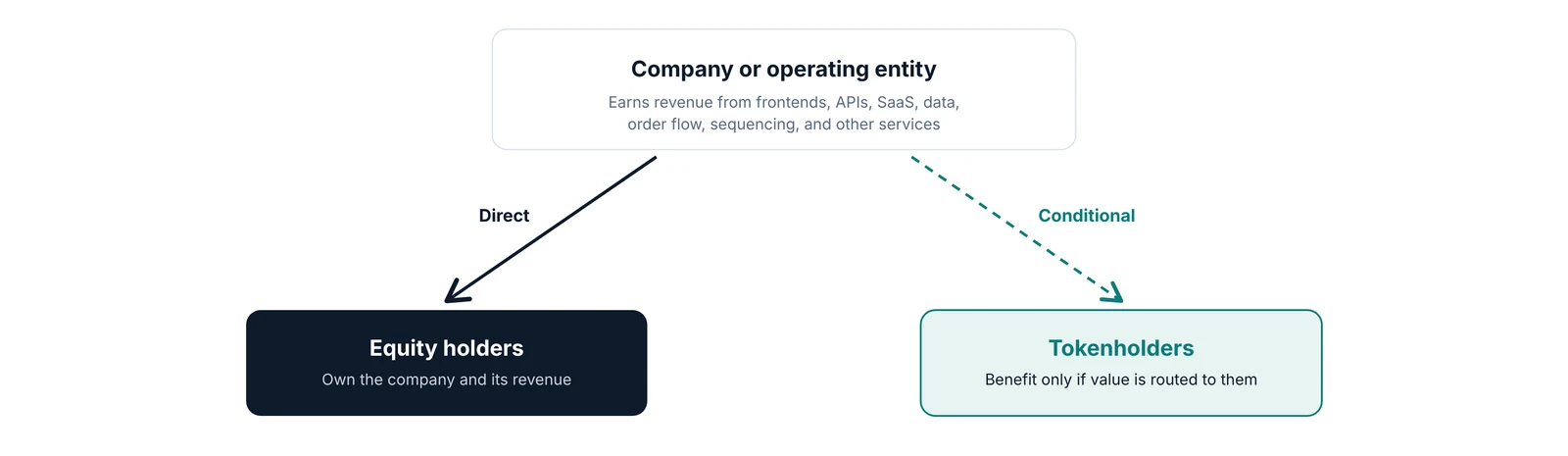
Figure 6. Investors can be right about the company and still be wrong about the token.
5.1 Equity/Token Separation
Value can sit in the token, the protocol, the treasury, or an affiliated company or operating entity whose equity is separate from the token. This equity/token separation becomes important when that entity earns revenue that does not reach tokenholders. For example, a company might run the main frontend or hosted infrastructure and keep the fees, while the token only governs the protocol. In that case, holders have no exposure to the company's revenue, no matter how much the network grows.
Holders benefit only if value reliably reaches them, whether through programmatic accrual, governance-controlled routing, or a consistent discretionary policy. The weaker the connection, the larger the discount.
Four questions test equity/token separation:
Does the company or operating entity monetize independently from the token?
Do tokenholders control or share in the part of the business that earns revenue?
Are buybacks, burns, distributions, or treasury transfers programmatic, governance-dependent, or discretionary?
Could the business continue to grow while tokenholder economics remain weak?
If the answer to the fourth question is yes, CAVF values the company and the token separately, usually with a sum-of-parts model, monetization leakage analysis, or an event-driven accrual model.
5.2 Ownership Tokens
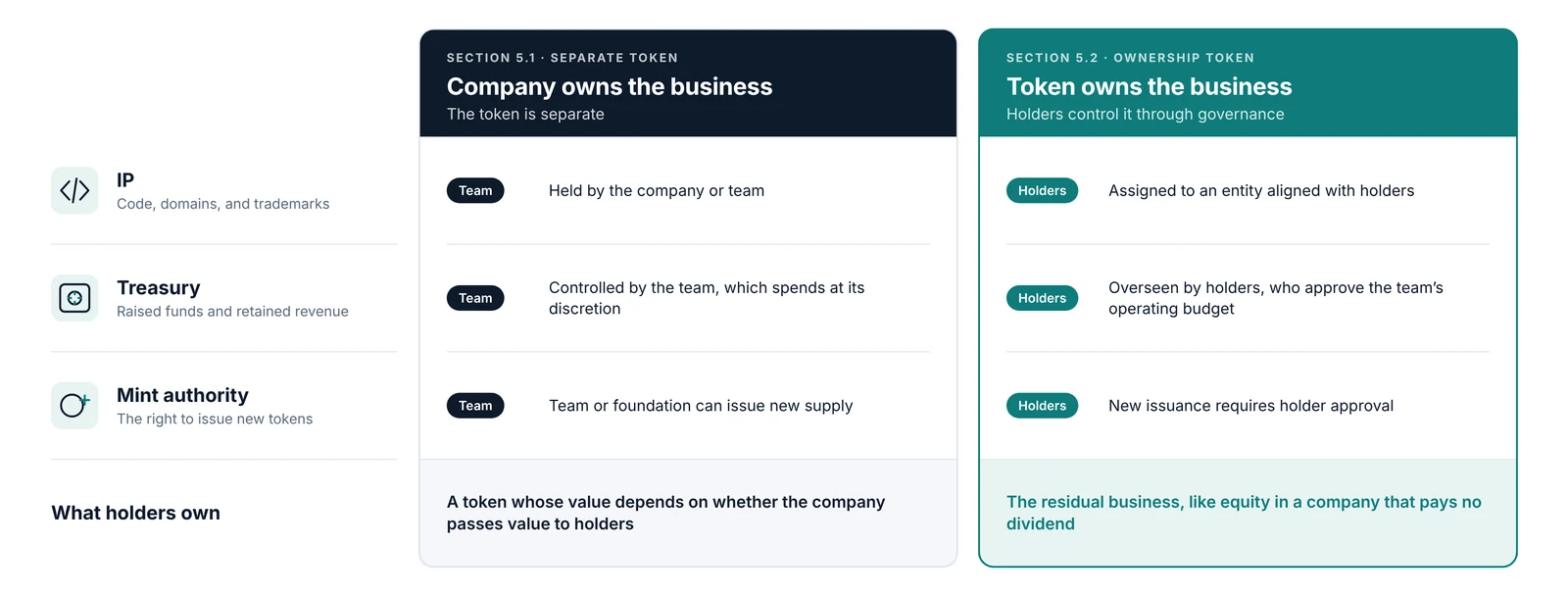
Figure 7. Ownership token holders control the IP, treasury, and mint authority.
Section 5.1 covers projects where a company owns the business separately from the token. With ownership tokens, the token owns the business instead. Through governance, holders control the treasury, the intellectual property (IP), and the authority to issue new tokens, while the team runs the business on a budget that holders oversee.
An ownership token might never buy back or burn a single token and still give holders a strong claim. Because holders own the residual business rather than a stream of payments, the project can reinvest all of its revenue into growth, like a company that pays no dividend. These tokens will often show little or no accrual once new supply is counted (Section 6.3). Such low accrual says little about what holders own, so CAVF judges ownership tokens by the structure that protects that ownership.
Six questions test how well the structure protects holders' ownership:
Who holds the IP, including code, domains, and trademarks?
Determines whether holders own the business or only its token.
Who controls the treasury, and can holders recover funds if the project fails or winds down?
Determines the downside floor.
Who controls the mint authority, and how is new issuance approved?
Determines dilution risk.
Who approves spending above the operating budget?
Determines whether reinvestment is overseen or discretionary.
Do insiders earn their stake on a time-based schedule or by hitting token price targets?
Determines whether insider dilution is tied to performance.
Can the revenue be verified?
Determines how much of the reported revenue counts toward the valuation.
The sixth question is most important for businesses that earn revenue offchain, such as data or hardware networks that bill customers directly. Offchain revenue depends on the company's own reporting, so CAVF counts it in full only when backed by audited statements, third-party attestations, or regular onchain settlement, and discounts it otherwise.
Projects launched through MetaDAO issue ownership tokens. Funds raised go into a treasury that tokenholders oversee instead of going to the team, and the IP is assigned to an entity aligned with holders. Spending above the monthly budget, new token issuance, and wind-downs all require approval through decision markets, where traders bet on whether a proposal will raise or lower the token price.7
Ownership tokens belong in the value-accrual category, with treasury retention as the main accrual channel, but the claim extends beyond the treasury. CAVF values them like equity in a company that does not pay dividends. If an ownership token runs buybacks or distributions, they are not added on top because they pay out cash the business value already includes (Section 6.4). The valuation takes three steps:
Treasury-adjusted NAV: Liquid treasury assets (net of committed spending) set a floor when holders have a right to recover them. Without a recovery right, CAVF discounts the treasury for governance control and spending policy, as in Section 4.1.
Business value: The operating business is valued on its own revenue or free cash flow using a DCF or comparable multiples because holders own the residual rather than a fixed share of fees. Interest and yield earned on treasury assets are excluded, since the treasury-adjusted NAV already captures them.
Protection discount: CAVF applies a discount to both the treasury value and the business value based on the answers to the six questions above. If holders control the treasury, IP, and mint authority, the discount is small. The more the team controls, the closer the discount gets to that of a discretionary claim (Section 6.1).
6 Enforceability, Leakage, and Dilution
Value-accrual quality depends on three variables: enforceability, leakage, and dilution.
A token can have a value-accrual mechanism on paper and still deliver little to holders if the mechanism is reversible, most of the economics leak to other parties first, or new supply grows faster than what holders receive. Section 6.4 then tests whether the project's choice between buying back tokens and reinvesting revenue creates or destroys value for holders.
6.1 Enforceability
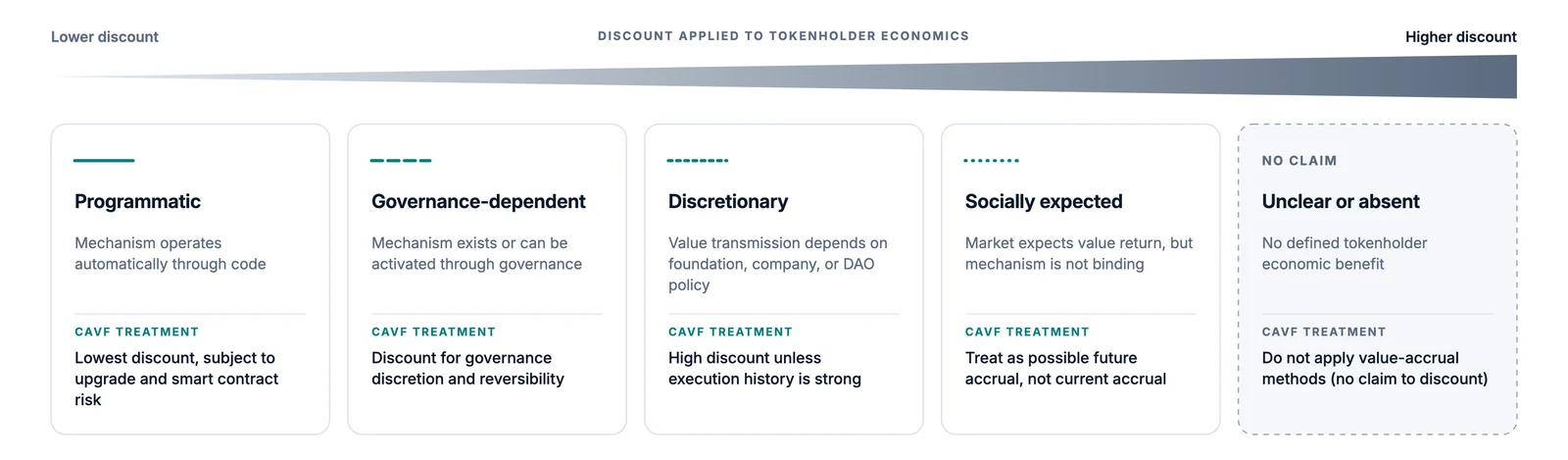
Enforceability measures how durable and credible the tokenholder claim is. Most tokens do not give holders the legally enforceable residual claim that equity does, so CAVF describes their position as economic exposure or value accrual, not a formal right to cash flows. In crypto, enforceability may be programmatic, governance-dependent, discretionary, socially expected, or unclear or absent.
Figure 8. Claim quality determines the discount applied to tokenholder economics.
Ownership tokens rely on a related form of protection. Instead of relying on distributions, holders control the treasury, IP, and mint authority directly (Section 5.2). When the structure enforces that control, the claim ranks close to programmatic. When it depends on the team's promises, the claim ranks as discretionary.
How long a claim lasts also affects its value. CAVF counts a buyback or distribution program with a set end date only through that date, with the usual discount for its enforceability. Accrual after that date is weighted by the probability that the program is renewed, which is low if the team has made no commitment to renew it. A program with no end date that the team can change at any time takes the discretionary discount on all of its accrual.
6.2 Economic Leakage
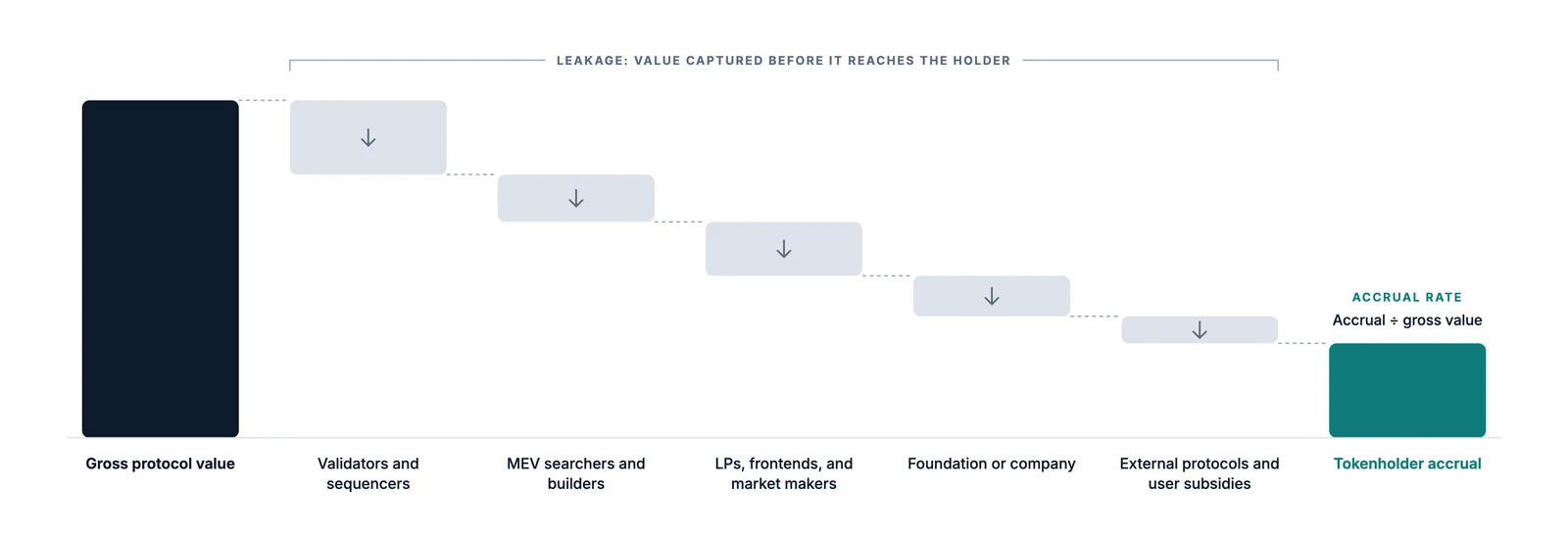
Economic leakage measures how much protocol value is captured by others before reaching tokenholders. Leakage is not necessarily problematic, since validators, LPs, companies, and others may provide essential services. The size of each leak depends on the protocol. For example, a validator that charges a 10% commission on its stakers' rewards leaks 10%, while one that charges no commission and passes through all fees leaks nothing.
Figure 9. Only what reaches holders counts as tokenholder economics.
Common leakage recipients include validators, sequencers, MEV searchers and builders, LPs, frontends, market makers, foundations, companies, external protocols, and subsidized users. Six questions size leakage:
What share of gross value reaches tokenholders?
Determines the accrual rate.
Who captures the remainder?
Identifies the leakage channels.
Who does the leakage come from, the protocol or the users?
Determines whether it costs tokenholders or only users.
Is leakage structural or temporary?
Determines whether the current accrual rate will last.
Can governance redirect leakage?
Determines whether holders could capture more in the future.
Does leakage increase as the protocol scales?
Determines long-run accrual assumptions.
Leakage affects tokenholders only when it comes out of the value the protocol could otherwise keep. MEV that searchers take from traders is a cost to traders, not to tokenholders, and the priority fees searchers pay for that MEV accrue to the L1's stakers. A lending protocol that hands liquidation bonuses to outside liquidators, by contrast, gives up value it could have kept.
A high-revenue protocol with high leakage may be valuable as a protocol but weak as a token.
6.3 Dilution
Dilution is new supply that shrinks each holder's share of the token. It comes from emissions, staking subsidies, incentives and grants paid from reserves, treasury sales, and governance-authorized issuance. A buyback or burn figure on its own overstates what holders get because it ignores this new supply.
CAVF corrects for new supply with dilution-adjusted accrual yield, or DAAY:
DAAY = holder accrual yield − net issuance yield
A positive DAAY means accrual exceeds dilution, and a negative DAAY means the reverse.
Holder accrual yield is the value that reaches holders through buybacks, burns, and distributions funded by protocol revenue, annualized from a recent window (usually the last 30 or 90 days), divided by the market value of outstanding supply. Buybacks count when the tokens are bought and are not double-counted if they are later burned. If the treasury releases bought-back tokens instead of burning them, they count as issuance.
Outstanding supply includes every token that has been issued to an owner, including locked team and investor tokens, but excludes unallocated treasury, ecosystem, community, and foundation reserves.
Net issuance yield is the realized growth in outstanding supply over the trailing 12 months from new emissions, governance-authorized minting, staking subsidies, and reserve tokens that left the issuer's control through incentives, grants, sales, or ecosystem and foundation releases. Burns are already counted in holder accrual yield, so they are not subtracted again in net issuance yield.
Holder accrual yield and net issuance yield use different windows deliberately. Accrual programs change abruptly, as fee switches turn on and buybacks start, pause, or get resized, so a recent run rate best reflects what holders receive at today's price. Conversely, issuance is lumpy, with reserve releases, grants, and incentive seasons arriving in batches, so a short window would overstate dilution in a heavy month and hide it in a quiet one. Twelve months captures a full cycle. Together, the two windows keep DAAY conservative, since a discontinued program cannot prop up accrual and one quiet month cannot hide dilution.
Unlocks are not dilution. When locked team or investor tokens unlock, they were already part of outstanding supply, so no holder's share changes. What changes is how much supply can trade, and large unlocks often bring selling pressure. CAVF tracks unlocks separately from DAAY, as an input for float and near-term price pressure.
Releases from ecosystem, community, or foundation reserves work differently. Unlock calendars often list them alongside team and investor unlocks, but reserve tokens enter outstanding supply only when they leave the foundation or treasury through grants, incentives, distributions, or sales. At that point, they count as issuance. Tokens that vest into a foundation wallet and stay there are still reserves.
Figure 10. A one-year DAAY example: 5% holder accrual yield minus 12% net issuance yield gives a DAAY of −7%.
For example, take a token whose outstanding supply is worth $500 million and whose protocol buys back and burns $25 million of tokens a year. Its holder accrual yield is 5%. Emissions and incentives paid from reserves added 12% to outstanding supply over the past year, so its DAAY is −7%. The buybacks offset less than half of the new supply.
DAAY measures how much value reaches holders after dilution. How a project spends its revenue, on buybacks or on reinvestment, also adds or destroys value depending on the token's current price.
6.4 Buybacks Versus Reinvestment
Buybacks and reinvestment are both ways to use the same revenue, and neither is better by default. A buyback aims to return value to holders by reducing supply, while reinvestment aims to increase the value of the business those holders own. The right choice depends on the token's price relative to its fair value and on the return the business can earn on new capital, which is usually higher for early-stage projects than for mature ones.
A buyback creates value for holders only when the protocol buys below fair value. The protocol pays with treasury money or revenue that would otherwise go to the treasury. That money belongs to all holders and was already part of each token's value. Whether the tokens it buys are burned or held in the treasury, they leave the market, so each remaining token owns a larger share of the business. That larger share is worth more than the cash given up only when the buyback price is below fair value. Above fair value, the protocol overpays sellers out of the shared treasury.
Figure 11. A $10M buyback raises value per token only below fair value; above it, sellers get overpaid from the treasury.
For example, if a protocol's business is worth $200 million, its treasury holds $10 million in cash, and 100 million tokens are outstanding, each token's fair value is $2.10. Spending the $10 million at $1.50 takes 6.7 million tokens off the market (worth $14 million) and leaves each token worth $2.14. Spending it at $2.25, just above fair value, takes 4.4 million tokens off the market (worth $9.3 million) and leaves each token worth $2.09. Spending it at $3.00 takes only 3.3 million tokens off the market (worth $7 million) and leaves each token worth $2.07. At $3.00, the protocol overpays sellers by $3 million out of the shared treasury, even though the buyback reduces supply and raises DAAY.
Reinvestment creates value when the expected return on new spending exceeds the return from buying back the token at its current price. That return has to reach holders later, either as revenue paid to them or as growth in the treasury and business they own. If it does not, reinvestment has the same effect as leakage.
DAAY measures how much value reaches holders, but not whether that value was spent well. As the example above shows, a buyback can raise DAAY and still destroy value. Fixed buyback rules add a second problem. Because these rules set buybacks at a fixed share of revenue, the protocol usually buys the most when revenue and token prices are highest and the least near the bottom of a cycle, when tokens are cheapest. Four questions test whether capital is allocated well:
Is the token trading above or below its base-case fair value?
Determines whether buybacks create value for remaining holders.
What has reinvested capital earned in the past?
Determines whether forecasts should assume reinvestment will pay off.
Who decides between buybacks and reinvestment, and under what rules?
Determines whether the choice is disciplined or discretionary.
Is the spending disclosed in enough detail to measure results?
Determines how much the valuation can rely on the project's capital allocation.
A project that buys back below fair value, reinvests only at high returns, and reports both generally creates more value for holders than one with a larger but fixed buyback.
7 Selecting the Right Valuation Method
Token classification narrows the set of relevant valuation methods, but the final method depends on the specific tokenholder claim.
A governance token with no current accrual is valued differently from one with an active fee switch. An infrastructure token with fee burn is valued differently from one where most economics accrue to validators, sequencers, or an operating company. A value-accrual token with programmatic buybacks is treated differently from one that depends on discretionary governance action.
For this reason, CAVF separates classification from method selection. Classification identifies the token's economic type. Method selection determines which model best fits the tokenholder claim after accounting for enforceability, leakage, and dilution.
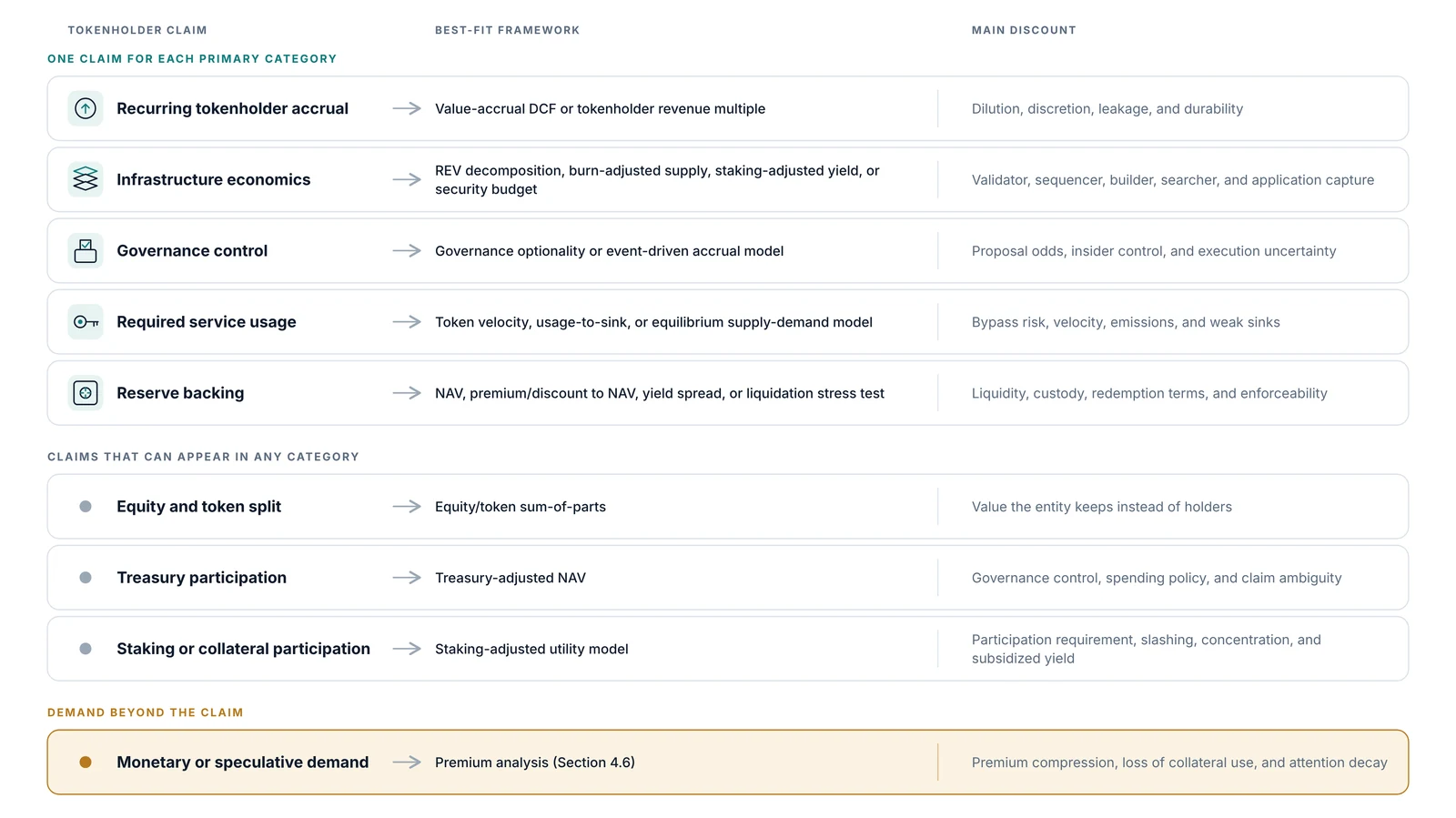
Figure 12. Each tokenholder claim points to a best-fit framework and a main discount.
Each type of tokenholder claim calls for a different best-fit framework and carries a different main discount, as shown in the figure above. The first five claims correspond to the five token categories in Section 4:
Recurring tokenholder accrual. Holders already receive value on a regular basis. The best fit is a value-accrual DCF or a tokenholder revenue multiple.
Infrastructure economics. Value flows through validators, sequencers, and other network participants before any of it reaches holders. Valuation starts with REV decomposition and adds burn-adjusted supply, staking-adjusted yield, or a security budget model where they apply.
Governance control. Governance can direct value to holders but has not yet done so. The token is valued with governance optionality or, once a specific proposal is pending, an event-driven accrual model.
Required service usage. Users must hold the token to access the network. The best fit is a token velocity model, a usage-to-sink model, or an equilibrium supply-demand model.
Reserve backing. The token is backed by assets held in reserve. Valuation starts from NAV and adjusts it with premium/discount to NAV, yield spread, or a liquidation stress test.
Three more claims can appear in any category and are valued alongside the token's primary claim:
Equity and token split. A company or operating entity earns revenue that may not reach tokenholders. The best fit is an equity/token sum-of-parts, which separates the value that the entity keeps from the value that reaches holders.
Treasury participation. Holders have some claim on a treasury but receive no distributions. The best fit is a treasury-adjusted NAV.
Staking or collateral participation. Holders must stake or lock the token as collateral to earn fees or rewards. The best fit is a staking-adjusted utility model.
Some demand is not a claim at all, so CAVF sizes it separately:
Monetary or speculative demand. The market pays for the token as money or as a bet, beyond what the tokenholder claim supports (Section 4.6).
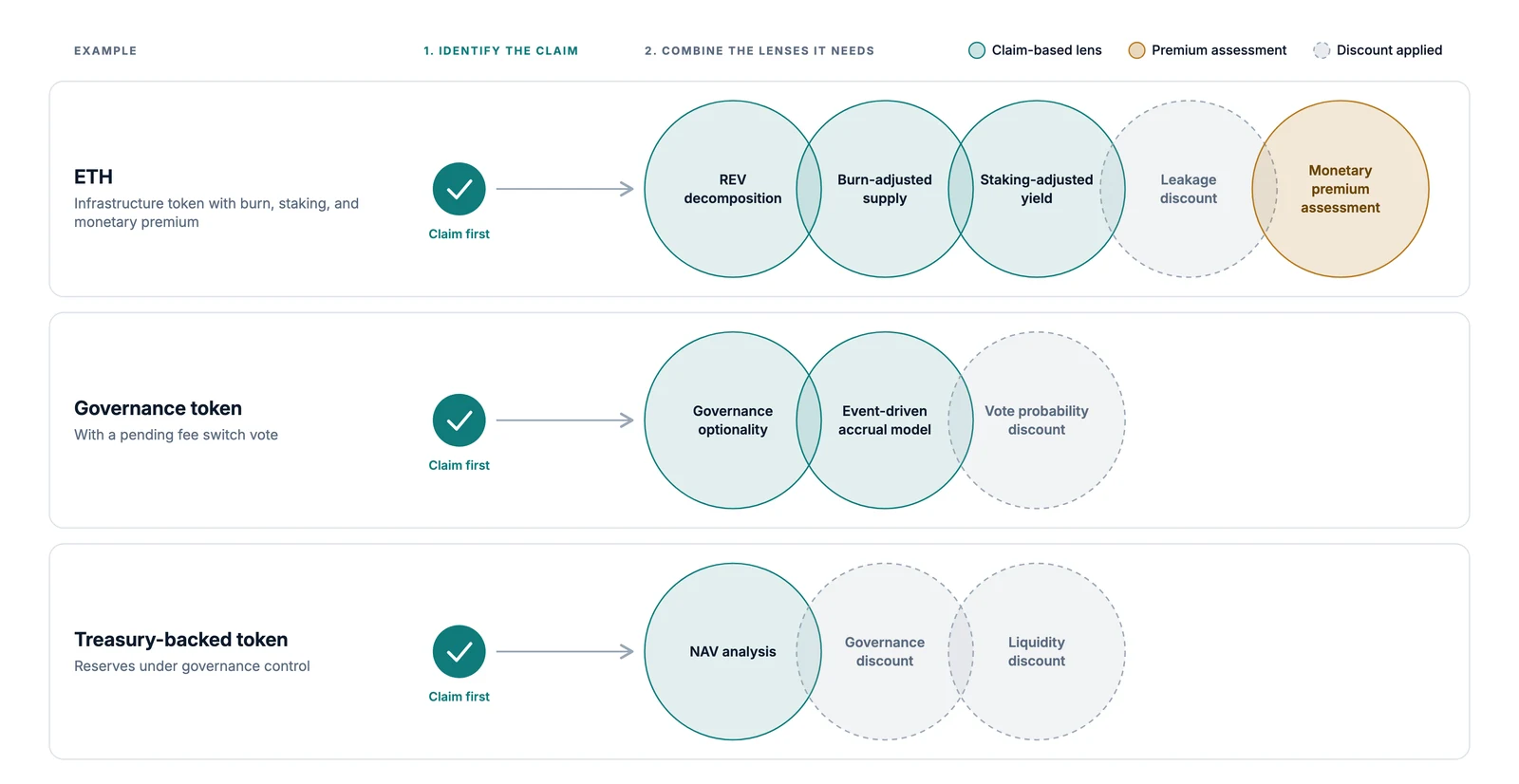
Figure 13. Tokens often need several lenses, and the claim is always identified first.
In practice, many tokens require more than one valuation lens, and this framework is a method-selection guide rather than a rigid taxonomy. ETH, for example, may require REV decomposition, burn-adjusted supply analysis, staking-adjusted yield, and a separate monetary premium assessment. A governance token with a pending fee switch vote may require an event-driven accrual model for the vote and governance optionality for economics no one has proposed yet. A treasury-backed token may require NAV analysis alongside governance and liquidity discounts. Models can be combined, as long as the tokenholder claim is identified before the first one is applied.
Once the claim has been valued, a reverse DCF can serve as a cross-check for tokens with measurable holder accrual. A reverse DCF takes the current price and calculates how fast holder accrual would need to grow to justify that price. That growth rate can then be tested against the claim valuation without changing it.
For example, take a token whose outstanding supply is worth $1 billion and that generates $25 million a year of holder accrual. With a 15% discount rate and a 15x terminal multiple on year-five accrual, that accrual has to grow about 34% a year for five years to justify the price. If the claim valuation's bull case assumes only 20% growth, then the claim is worth about $606 million, and, with no monetary use, the remaining $394 million is speculative premium (Section 4.6).
8 Case Study Applications
The following case studies are illustrative. They are not full valuation models and should not be read as price targets. Their purpose is to show how CAVF classifies tokens and selects the correct valuation lens. Each one reflects the protocol's design as of November 2026.
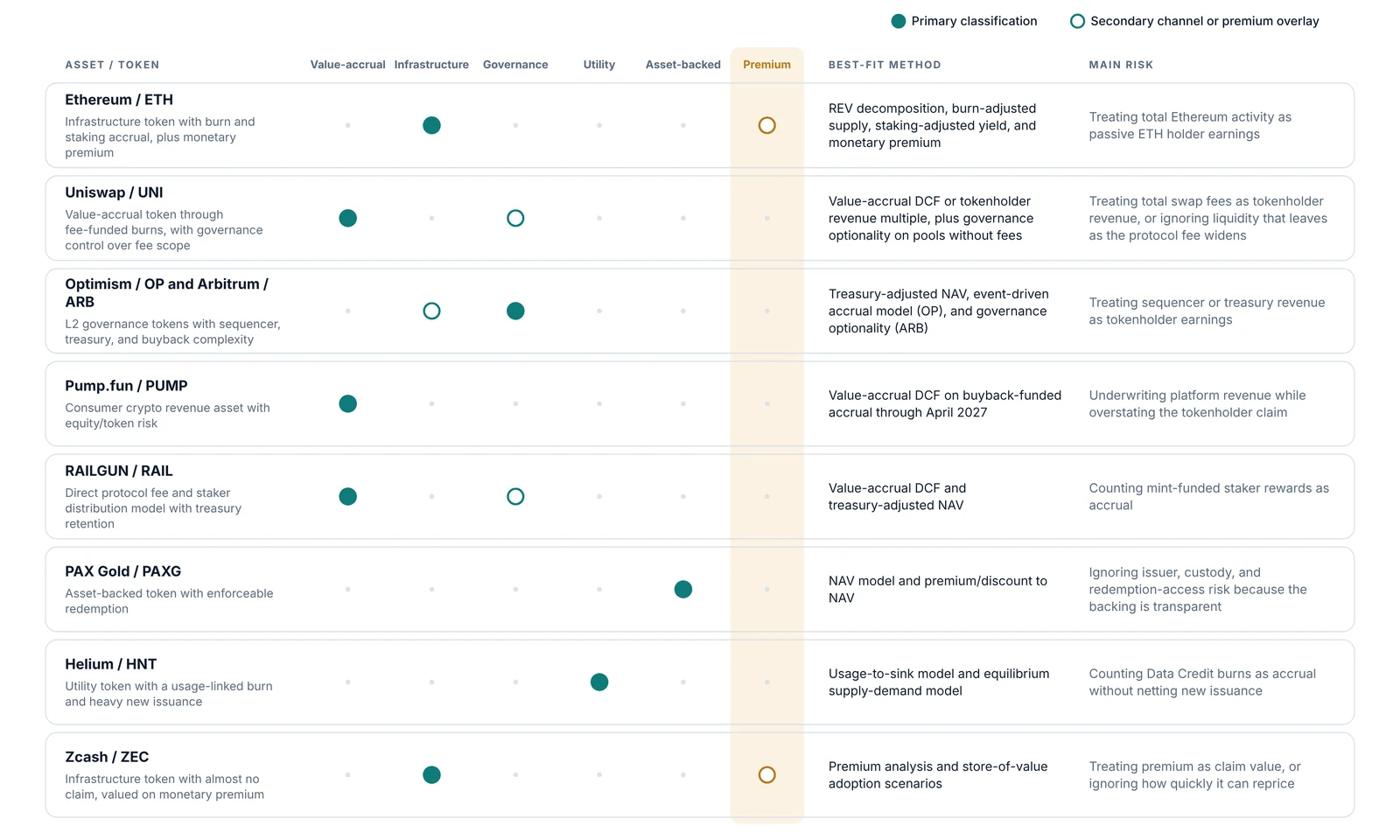
Figure 14. Eight examples of CAVF method selection across all five categories.
8.1 Ethereum / ETH
ETH is best analyzed as an infrastructure token with monetary, security, and productive components. Users pay base fees and priority fees to get transactions included, and searchers pay validators for the right to capture MEV. EIP-1559 burns the base fee,8 and EIP-4844 burns the blob fees paid by L2s,9 while priority fees and MEV go to validators and stakers, not to holders who do not stake. ETH also carries a monetary premium because it serves as collateral and a settlement asset.
CAVF therefore does not treat Ethereum REV as one earnings line. It splits REV into burn, priority fees, and MEV, accounts for value that leaks to L2s, nets the result against issuance, and values monetary premium separately before deciding which economics reach ETH holders.
The best-fit approach to ETH combines burn-adjusted supply, staking-adjusted yield, and a separate monetary premium assessment, with dilution as the main discount.
8.2 Uniswap / UNI
UNI used to be the clearest example of the gap between protocol value and tokenholder value. Uniswap processed tens of billions of dollars in monthly volume while UNI only governed the protocol. That changed with UNIfication, which passed in December 2025, burned 100 million UNI from the treasury, and turned on protocol fees for v2 and v3 pools on Ethereum.10
Governance has since extended the fee to more than ten chains and, in July 2026, to selected v4 pools.11 The accumulated fees can only be claimed by burning UNI, so holders benefit through a shrinking supply instead of a distribution. Under CAVF, UNI has moved from a governance token toward a value-accrual token.
The valuation now depends on the fee rate for each pool type, the share of total swap fees the protocol takes, whether that take pushes liquidity to competing venues, and how easily governance can change these settings.
The best-fit approach to UNI is a value-accrual DCF or tokenholder revenue multiple on burn-funded accrual, measured through DAAY, with the share of swap fees kept by LPs as the main leakage.
8.3 Optimism / OP and Arbitrum / ARB
OP and ARB show how a network can earn substantial sequencer revenue while holders have only an indirect or governance-dependent claim on it.
In January 2026, Optimism governance approved a 12-month pilot that uses 50% of the revenue Superchain chains pay to the Optimism Collective to buy OP each month.12 A month later, Base, the largest chain in the Superchain, announced it would move to its own stack, and its revenue share to the Collective ended, so the buyback now runs on a much smaller revenue base.13 The OP it buys goes to the Collective treasury, and governance will decide later whether to burn it, use it for staking, or spend it.
Arbitrum has no protocol buyback mechanism. Fees from Arbitrum One, including its priority fee auctions and Fast Feed subscriptions, go to the DAO treasury, and tokenholders decide through governance how that money is spent.14 Other chains built on Arbitrum's technology, including Robinhood Chain, also pay a share of their fees into the same treasury.15
For OP and ARB, CAVF separates sequencer revenue, treasury capture, buyback mechanics, governance discretion, and tokenholder accrual. OP tokens bought back into a treasury are closer to treasury retention than to a burn until governance decides what to do with them. ARB's treasury collects fees, but holders have no defined claim on them.
The best-fit approach to OP and ARB is a treasury-adjusted NAV plus an event-driven accrual model for OP and governance optionality for ARB, with governance discretion as the main discount. OP's value depends on whether governance burns the tokens it buys, and ARB's on whether governance ever directs treasury fees to holders.
8.4 Pump.fun / PUMP
Pump.fun shows why gross protocol revenue overstates what reaches tokenholders.
Since late April 2026, Pump.fun has spent 50% of its net revenue buying PUMP on the open market and burning it. Including an earlier program that used all of its revenue, cumulative buybacks had passed $500 million and removed more than 17% of total supply by November 2026.16 The burns are permanent, but Pump.fun controls the contract and can change the buyback rate at any time.17 The program is also set to end in April 2027, and Pump.fun has not committed to renewing it. Under CAVF, that makes the claim discretionary. Accrual through April 2027 counts at the current buyback rate, discounted for the risk that Pump.fun lowers it. After that date, accrual is weighted by the probability that the program is renewed (Section 6.1).
As a result, CAVF does not value PUMP on gross platform revenue. It breaks revenue into creator fees, cost of revenue, gross profit, and the share that reaches tokenholders through buybacks. Creators, operating costs, and the company's half of net revenue are all paid before tokenholders receive anything, and the buyback depends on a rate the company sets.
The best-fit approach to PUMP is a value-accrual DCF on buyback-funded accrual through April 2027, with company discretion and renewal risk as the main discounts.
8.5 RAILGUN / RAIL
RAILGUN shows a path from protocol activity to tokenholders that can be traced end to end. The protocol charges a 0.25% fee when users shield or unshield assets. Those fees go to the DAO treasury, and every two weeks the protocol distributes a share of the eligible treasury balance to active RAIL stakers. CAVF treats the fees paid out to stakers and the fees kept in the treasury differently.
Staker distributions count as observable accrual for holders who stake. Retained treasury value adds to holder value only after discounting for liquidity, governance control, and spending policy.
RAILGUN also shows how dilution works against accrual. In July 2026, the DAO approved a one-time mint of 2.5 million RAIL to the treasury to fund more staker rewards.18 RAILGUN's staker rewards funded by shield and unshield fees are accrual, while rewards funded by the new mint raise staker yield without adding accrual, so CAVF treats them as issuance when they are paid out.
The best-fit approach to RAIL is a value-accrual DCF on fee-funded staker distributions plus a treasury-adjusted NAV, measured through DAAY, with dilution from the mint as the main discount.
8.6 PAX Gold / PAXG
PAX Gold is the simplest asset-backed case. Each PAXG token represents one fine troy ounce of London Good Delivery gold held in allocated vaults by Paxos Trust Company, and holders can redeem tokens for physical gold or cash.19 There is no protocol revenue, governance, or treasury to analyze. The token is a claim on a specific asset.
Enforceable redemption keeps its price close to the value of the gold it represents. The main discounts come from issuer and custody risk, the frequency of reserve attestations, and redemption frictions. Physical redemption requires 430 tokens, the size of one bar, so smaller holders rely on cash redemption or secondary markets. PAXG is a useful benchmark for the rest of the asset-backed category. Most asset-backed tokens have weaker redemption rights than PAXG, and the weaker the right, the larger the discount to NAV.
The best-fit approach to PAXG is a NAV model, with issuer and custody risk as the main discount.
8.7 Helium / HNT
HNT is a utility token with a usage-linked sink. Customers pay for network data in dollars, and that payment is converted into HNT and burned to create Data Credits at a fixed price of $0.00001 each.20 Usage removes HNT from supply, and new HNT is minted to reward hotspot operators, based on the data they carry rather than coverage alone. In January 2026, Helium stopped the separate buybacks it had funded with Helium Mobile subscription revenue, so Data Credit burns are now the main link between usage and the token.21
HNT also shows how new supply can work against a usage-linked sink (Section 6.3). In July 2026, governance approved HIP-149, which mints about 141 million new HNT (roughly 75% of current circulating supply) into a multisig vault over 36 months to fund operations and growth.22 These tokens count as issuance in DAAY as they leave the vault, and about half are scheduled for release in the first year. For the usage-to-sink model to support HNT, Data Credit burns would have to outpace that issuance.
The best-fit approach to HNT is a usage-to-sink model, with dilution from HIP-149 as the main discount.
8.8 Zcash / ZEC
Zcash is the case where nearly all of the value is premium. It launched in 2016 on a fork of Bitcoin's codebase and kept Bitcoin's monetary design, with a 21 million supply cap, proof-of-work mining, and a halving roughly every four years. It added optional privacy through shielded transactions. Like BTC, ZEC is held mainly as a store of value. It has no protocol revenue, fee switch, or treasury claim for holders. New issuance is about 657,000 ZEC a year (1,800 a day), with 80% going to miners and 20% to development funding.23 Under CAVF, ZEC's primary category is infrastructure because the token pays for and secures its own network; but it has no tokenholder claim, so its market value is mostly monetary premium.
Section 4.6 says monetary premium is strongest when a token is held and used as money, its supply policy is credible, and its liquidity is deep. The share of supply in shielded pools shows how much ZEC is held as a store of value rather than traded. Supply policy is set by tokenholder vote, and in September 2026, holders voted to keep the four-year halving schedule.24 Liquidity and access improved in August 2026, when the first U.S. spot Zcash ETF began trading.25 ZEC also shows how fragile premium can be. When a counterfeiting flaw in the Orchard shielded pool was disclosed in June 2026, ZEC fell roughly 50% in two days, even though no counterfeit coins were found.26 ZEC has no tokenholder claim, so the entire drop came from premium.
The best-fit approach to ZEC is a monetary premium assessment (Section 4.6), sized against BTC and gold adoption scenarios, with premium compression as the main risk.
9 CAVF Implementation Sequence
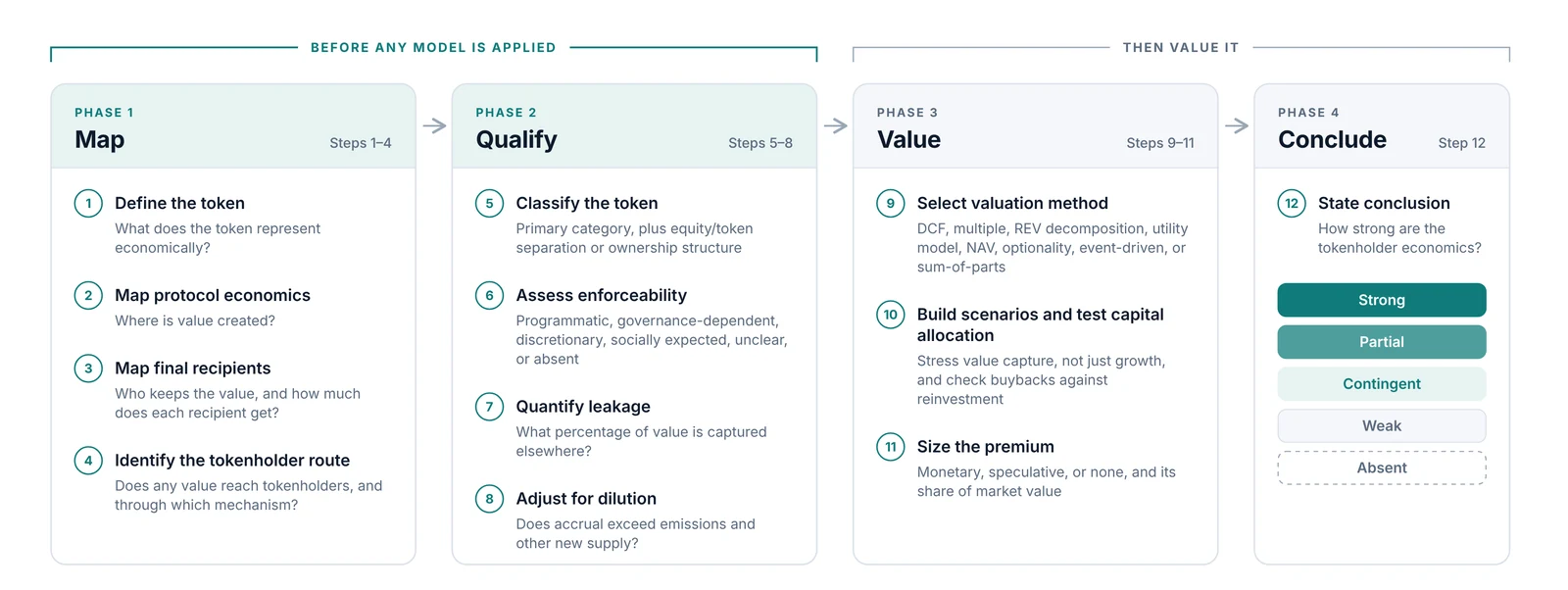
CAVF lays out a repeatable twelve-step sequence in four phases (Map, Qualify, Value, and Conclude). Every analysis starts with the tokenholder claim before any multiple, DCF, NAV, or velocity model is applied. The steps below are written as instructions for applying CAVF to a token.
Figure 15. The twelve-step sequence in four phases: Map, Qualify, Value, and Conclude.
Map (steps 1–4): Start by defining what the token represents economically. Then map where the protocol creates value, who keeps that value, and how much each recipient gets (Section 3). The phase ends by identifying whether any value reaches tokenholders and through what mechanism. If no mechanism is live or proposed and the token has no required use, the rest of the analysis is about premium.
Qualify (steps 5–8): Classify the token by its primary claim (Section 4). Check for equity/token separation (Section 5.1), and if it is an ownership token, test the structure that protects it (Section 5.2). Then test the claim by how enforceable it is (Section 6.1), how much value leaks to other parties first (Section 6.2), and whether accrual outpaces new supply, measured by DAAY (Section 6.3).
Value (steps 9–11): Only now select a valuation method that fits the claim (Section 7). Build scenarios that stress how much value reaches holders, not just how fast the protocol grows, and check whether the project's split between buybacks and reinvestment creates or destroys value (Section 6.4). Then size the premium, monetary or speculative, as its own share of market value (Section 4.6). Where the token has measurable holder accrual, a reverse DCF can also show what growth the price assumes (Section 7).
Conclude (step 12): State whether the token has strong, partial, contingent, weak, or absent tokenholder economics. Strong means accrual is programmatic or has a consistent discretionary track record, leakage is low, and DAAY is positive. Partial means accrual is weakened by leakage, discretion, or dilution. Contingent means accrual depends on a vote or decision that has not happened yet. Weak means a mechanism exists, but leakage or dilution overwhelms it. Absent means nothing reaches holders: no mechanism is live or proposed, and the token has no required use.
10 Conclusion
This paper and CAVF aim to standardize the first step in crypto valuation, which is determining whether tokenholders participate in the value the protocol creates. Doing so means separating protocol economics from tokenholder economics, mapping value to its final recipient, classifying the token by its primary claim, and adjusting for enforceability, leakage, and dilution.
Only then does choosing a best-fit valuation method make sense. Valuation still requires judgment, but with CAVF, that judgment starts from the tokenholder claim.
One of the most useful conclusions CAVF can reach is also the simplest:
The protocol is valuable. The token is not.
Acknowledgements
I am grateful to Hiroki Kotabe (Lemniscap, @blockhiro), Luke Leasure (Blockworks, @0xMether), AJC (@AvgJoesCrypto), and Youssef Haidar (DCG, @0xYoussef_) for their valuable feedback and to the many others who reviewed earlier drafts.
Disclaimer
This whitepaper is for research and educational purposes only. It does not constitute investment advice, legal advice, tax advice, accounting advice, financial advice, or a recommendation to buy, sell, or hold any asset. Crypto assets involve substantial risk, including market risk, liquidity risk, governance risk, smart contract risk, regulatory risk, and total loss of capital. Tokenholder economics may change through governance, protocol upgrades, legal developments, market structure changes, or discretionary actions by foundations, companies, DAOs, or other participants. Readers should conduct independent research and consult appropriate professional advisors before making investment or governance decisions.
Disclaimer: This dashboard is for informational and educational purposes only. Nothing on it is investment, financial, legal, or tax advice, or an offer, solicitation, or recommendation to buy, sell, or hold any token. Ratings, scores, and fair values are the author's opinions, produced by applying a framework to data that may be incomplete, delayed, or wrong; fair values are scenario estimates, not price targets or forecasts. Crypto assets are highly volatile and you can lose all of the money you put in. Past ratings and the track record don't predict future results. The author may hold positions in tokens covered here. Do your own research and consider speaking with a licensed financial professional before making any investment decision.
Work in progress: This dashboard is still a work in progress and a living document, so information on it may be incomplete, inaccurate, or missing. To add or correct anything, reach out to @immutablejacob on X.